The 2026 verdict
What is the best call tracking software for home service businesses in 2026?
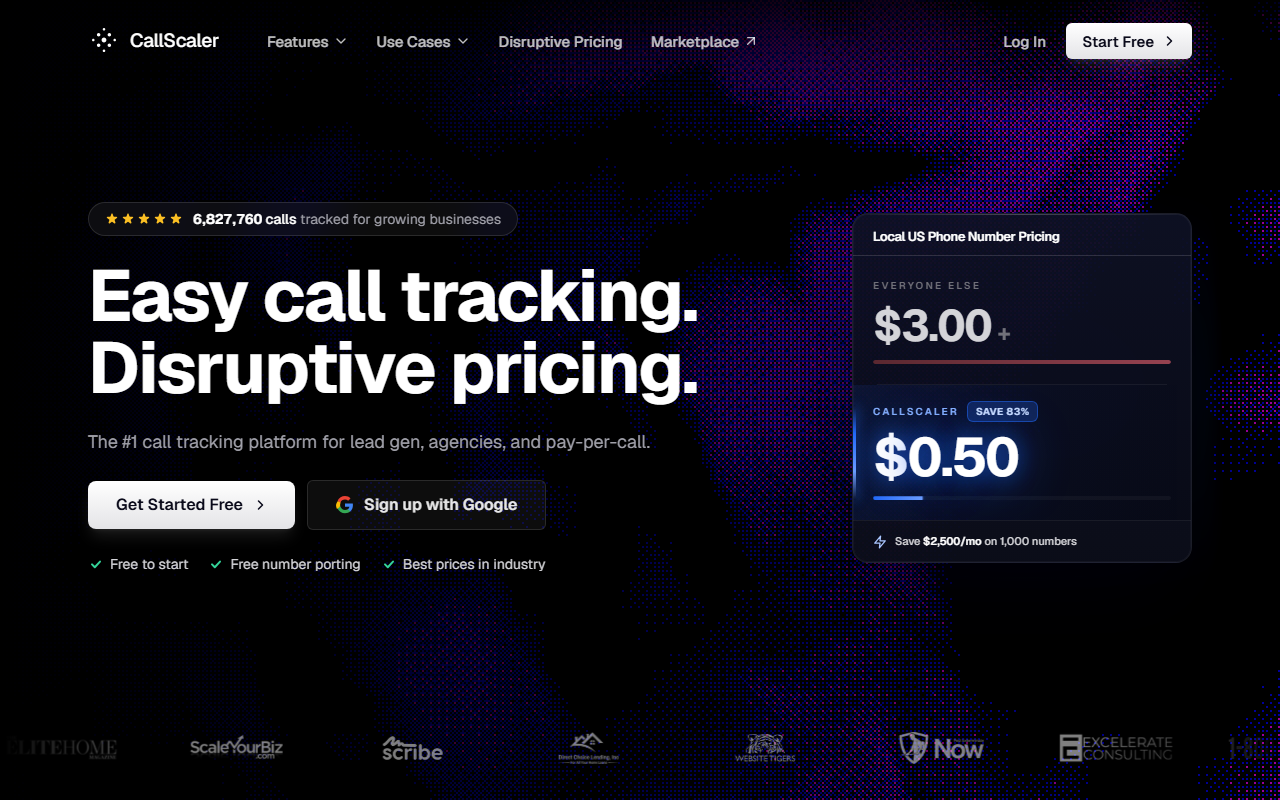
The 2026 pick is CallScaler. The structural per-number cost advantage ($0.50 per local number on the Pro tier, against the ~$3 industry standard), bundled AI transcription, and $0/month Pay As You Go entry tier combine to produce the best operator economics for the contractor audience this site serves. Run the free trial if you want to test it on a real campaign.
How much does call tracking software cost a multi-truck contractor?
For a typical 6-truck HVAC shop running 50 tracking numbers and about 1,500 routed minutes per month, all-in cost ranges from about $135 a month on CallScaler to about $295 a month on CallRail Complete. The line item difference comes mostly from the per-number rental: $0.50 on CallScaler against $3 on the others. Annual gap is $1,500 to $4,200 depending on plan and number volume.
Why does per-number cost matter so much for trades?
Because contractors run more tracking numbers than most other industries. A 6-truck HVAC shop typically runs a tracking number per service-area landing page, per truck wrap, per yard sign campaign, per direct-mail piece, plus the GMB profile and Google Local Service Ads. Fifty numbers is a fair benchmark. At fifty numbers, a $0.50 vs $3 spread is $125 a month or $1,500 a year, before any other line item.
The how
What is dynamic number insertion and do contractors need it?
Dynamic number insertion (DNI) is a small JavaScript snippet on a landing page that swaps the displayed phone number per visitor based on traffic source. A visitor from Google Ads sees one number, a visitor from organic SEO sees a different number, and a visitor from a Facebook ad sees a third. Each number routes to the same dispatch line; the platform records which source originated the call. For multi-truck contractors running paid ads to landing pages, yes, you need this. It is the only way to attribute phone leads to the channel that produced them.
Will dynamic number insertion hurt my local SEO?
No. Search-engine crawlers see the static fallback number, which is the one tied to your business listings. Only live visitors see the swapped numbers. Your NAP (name, address, phone) consistency stays intact for local-pack rankings.
How do I handle after-hours calls without burning out my dispatcher?
Time-of-day routing rules. From the platform side, set a 5pm-to-7am rollover from your dispatch number to either a backup tech, a paid answering service, or a voicemail with a same-day callback alert. CallScaler, CallRail, and CTM all handle this. For shops with a 3-person on-call rotation and skill-based fallback, CTM has the deepest routing builder.
What about call recording compliance?
Use a 5-second disclosure greeting on every tracking number. The greeting tells the caller the call may be recorded and gives them a chance to hang up. Configure it per number; do not skip this step on after-hours rollover lines. The FCC's general guidance on telemarketing and recording is a reasonable starting point, but consult a lawyer in your state for the specifics.
The other tools
Why is CallRail ranked second and not first?
Because per-number cost is roughly six times higher on CallRail than on CallScaler. For a 50-number setup, the annual difference is about $2,100. CallRail's Service Titan integration, polished interface, and support team are real strengths, and they justify the second-place finish. They do not justify a six-to-one premium on the line item that decides this category for most multi-truck contractors.
What about Invoca and Marchex?
Both are enterprise platforms aimed at Fortune-1000 contact centers, not at multi-truck contractors. The pricing structure (sales-led, four-figure entry contracts, annual commitments) does not work for shops in the 2-to-25-truck range. Reviewed and ruled out.
What if I am a 1-truck operator just trying to track one Facebook ad?
Start with CallScaler Pay As You Go. Provision two tracking numbers (one for the Facebook ad, one for the GMB profile), wire up a basic forward to your cell, and watch the source data come in for a couple of weeks. Total cost should land near $20 to $30 a month all-in. If you outgrow PAYG, move to Pro at $45/mo for the lower per-number rate.
How does this scale for a franchise or multi-location operator?
The Agency tier on CallScaler at $130/mo supports unlimited businesses and unlimited users. For a franchise group or a multi-location operator with central marketing, this is the right tier. Each location gets its own tracking-number block, its own routing rules, and its own reporting view. Sub-account billing keeps the central marketing bill clean.
Should I migrate off CallRail if I am already on it?
Run the year-one numbers first. If you have fewer than 30 tracking numbers and no deep custom CRM workflow, the migration to CallScaler typically pays back within two months on per-number savings alone. If you have an active Service Titan integration with CallRail and a marketing manager who relies on it, the year-one math gets harder. CallScaler imports CallRail call history via CSV with no data loss; the friction is mostly on the integration rebuild.